

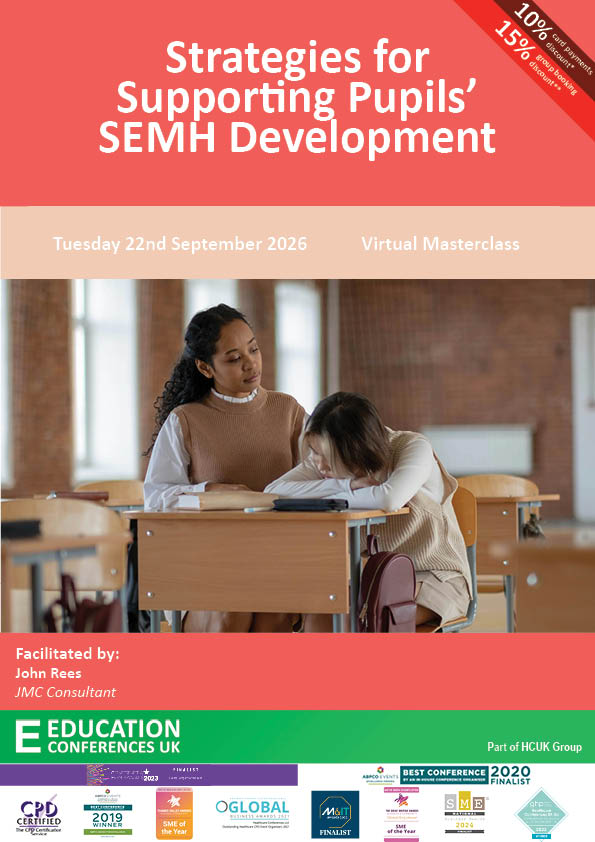
This masterclass is designed to move beyond theory and provide participants with a ‘psychological first aid kit.
It aligns with the DfE’s “Mental Health and Behaviour in Schools” guidance and the SEND Code of Practice, focusing on the teacher’s role in identification and classroom-based support.
This intensive masterclass is designed to bridge the gap between high-level theory and the daily realities of the classroom, empowering educators to manage Social, Emotional, and Mental Health (SEMH) needs with competence and compassion. Participants will move beyond reactive approaches to understand the neuroscience of emotional regulation, learning how to identify ‘survival mode’ behaviours before they escalate. By focusing on the ‘window of tolerance’ and evidence-based Emotion Coaching, staff will gain a robust toolkit of verbal scripts and environmental ‘sensory audits’ to reduce pupils’ anxiety and regain learning time. This is not just a behaviour course; it is a deep dive into building a relational culture where every child is emotionally ready to learn.
The session is mapped to the DfE’s “Mental Health and Behaviour in Schools” and the 2024 NPQ framework, ensuring your school meets the statutory requirements of the SEND Code of Practice. By implementing the ‘Assess, Plan, Do, Review’ cycle for emotional needs, this course directly supports the ‘Behaviour and Attitudes” criteria of Inspection, fostering the ‘predictable and safe’ learning environments expected by national policy.
Participants will leave not only with practical de-escalation strategies but also with a personal resilience plan, ensuring that the ‘oxygen mask principle’ protects staff wellbeing while meeting the increasingly complex needs of children and young people today.
KEY LEARNING OBJECTIVES
This masterclass will enable you to:
Analyse Behavioural Communication: Interpret disruptive or withdrawn behaviours as signals of unmet SEMH needs rather than simple non-compliance.
Implement Co-Regulation Tools: Apply “Emotion Coaching” scripts to help students navigate high-emotion states without escalating the conflict.
Adapt the Learning Environment: Design a classroom “toolkit” (including sensory tools and predictable routines) that supports students with attachment needs or anxiety.
Execute Statutory Duties: Correctly use school reporting systems to trigger early intervention as outlined in the SEND Code of Practice.
Develop Personal Resilience: Establish a personal “wellbeing boundary” to maintain professional effectiveness when working with high-need pupils.
WHO SHOULD ATTEND
Classroom Teachers & ECTs, Teaching Assistants & 1-to-1 Support, Pastoral Leads & ELSA Staff,SENDCo & Mental Health Leads and Midday Supervisors.
FACILITATOR
John is passionately committed to improving the learning and life chances of children and young people through the professional development of individuals and organisations.
Having taught for 12 years, latterly as a senior leader, John led the transformation of a theory-driven, evidence-informed health education research project from Exeter University. This eventually involved 200+ schools across the UK and overseas, with unique evidence of health benefits and educational improvement.
An independent educational advisor since 2006, John has been a Regional Advisor for the PSHE Association and the National PSHE CPD programme.
John currently works with Local Authorities, schools, and commercial organisations to support health and school improvement across the UK and overseas.
